The Enneagram Compatibility Pairing Nobody Warns You About — And Why the 'Good' Matches Aren't Always What They Seem

Photo by Land O'Lakes, Inc. on Unsplash
I once spent forty minutes at midnight cross-referencing my type on an enneagram compatibility site.
Type 9: ✓ high compatibility, "peaceful and harmonious." Type 4: ✓ "deep emotional connection." Type 8: ✗ "intense and potentially destabilising." I screenshotted the good ones. Went to sleep feeling vaguely reassured.
Then I dated a Type 9 for two years.
Peaceful, yes. But here's what the chart didn't mention: two people who both avoid conflict, together, in a flat, with a problem they can't name and won't bring up. The peace you get isn't tranquility. It's avoidance wearing a very convincing disguise. We were, technically, compatible. We were also both quietly miserable by month eighteen.
I'm not saying the charts are useless. I'm saying they're the beginning of the conversation, not the end of it. And the pairings they flag as "difficult" or "challenging"? Sometimes those are the ones that crack you open in the best possible way.

What Enneagram Compatibility Charts Actually Get Wrong
Most enneagram compatibility frameworks do the same thing: they rank pairings numerically and hand you a verdict. Type 2 and Type 6: high compatibility. Type 4 and Type 3: proceed with caution.
What they're actually measuring is surface-level behavioural similarity. Do both types like harmony? Good sign. Do both tend toward emotional volatility? Risk flag.
That logic holds for about thirty seconds, until you remember that a relationship isn't just two behaviour profiles living together. It's two people navigating their core fears in real time, in a room, under stress. Surface similarity doesn't protect you from that. Sometimes it makes it worse.
Two Nines together sounds like paradise. Peaceful, low-conflict, each one endlessly accommodating the other. In practice — and I've heard this from people in exactly this pairing — nothing ever gets decided. Nothing ever gets surfaced. Resentments pile up like snow nobody wants to acknowledge is falling. The conflict doesn't go away because they're "compatible." It just goes underground. And underground conflict is harder to deal with than the kind you can actually see.
Two Threes together sounds exciting. Ambitious, productive, each pushing the other forward. But both of them are in performance mode constantly, which means neither of them is real. You can spend two years with someone and realise you were both showing up as the most impressive version of yourself, not the one that actually needs something.

And Type 1 paired with Type 6 — which many charts rate as highly compatible, citing shared values and conscientiousness — is two anxious perfectionists catastrophising about different things simultaneously. That requires a remarkable amount of self-awareness to not spend most of your relationship managing each other's fears rather than actually being together.
The Enneagram Compatibility Pairings Nobody Mentions
Here's what the charts miss: it's not the pairing that determines whether it works. It's the level of health each person is operating at when they show up.
Type 8 and Type 4. Looks combustible on paper. Eights are blunt, direct, domineering when unhealthy. Fours are emotionally reactive and can vanish under pressure. The conflict potential is real. But Eights deeply respect authenticity above almost everything else — they would rather someone push back hard than perform niceness — and Fours are, by definition, allergic to performance. A healthy Eight and a healthy Four will fight. But they'll be actual fights about actual things, not the passive-aggressive cold war that some theoretically "compatible" pairs settle into. I've seen this pairing described as the most seen someone has ever felt. That's not nothing.
Type 5 and Type 2. Looks like a guaranteed disaster. The Five retreats into solitude; the Two pursues connection. The Two needs warmth and reciprocity; the Five needs space and autonomy. The books will tell you to brace yourself.
A couple I know — together for fifteen years, still clearly choosing each other — is a 5 and a 2. The Two learned, slowly and with some pain, that the Five's retreating isn't rejection. The Five learned that the Two's reaching out isn't an invasion of privacy. Both of them did the work. That matters more than any percentage.
Type 7 and Type 1. The Enthusiast and the Perfectionist don't look like a natural fit. The Seven wants to keep all options open; the One needs structure and closure. But a Seven can pull a One out of rigidity, and a One can give a Seven the container they need to actually finish something. When it works, it really works. The charts don't usually bother telling you that.

The pairings nobody warns you about aren't always the dramatic ones. They're the ones that look fine. That look compatible. Where the problems don't announce themselves upfront but accumulate quietly over years, because neither person is being challenged to grow.
Curious about your own type?
Take the free Enneagram personality test and get your full profile in minutes.
Discover Your Type →What Actually Determines Enneagram Relationship Compatibility
Stop asking "are we a good match." Start asking these instead.
What is my core fear, and how does it show up under stress? A Type 6's fear of being without support will make them cling when they're scared. A Type 3's fear of being seen as ordinary will make them disappear into work when they feel irrelevant. If your partner doesn't know what happens to you when your core fear gets triggered — and you don't know what happens to them — you're both operating in the dark, reacting to symptoms instead of the thing underneath.
Where do we each go in stress? The Enneagram's disintegration arrows show which type's unhealthy traits you move toward under pressure. A Type 7 under stress takes on the anxious rigidity of an unhealthy Type 1. A Type 4 under stress moves toward the grasping possessiveness of an unhealthy Type 2. If both of you hit your stress type simultaneously — and life will absolutely arrange for this to happen — the relationship takes the full impact. Knowing your stress arrows is a more useful map than compatibility percentages.
Are both of you in a relatively healthy place? I've seen Type 2 and Type 9 pairings that are among the most nurturing relationships I know. I've also seen the exact same pairing devolve into a codependent loop where neither person can make a decision alone. Same types. Completely different levels of health. The variable isn't the numbers.

Do you have compatible attachment styles, regardless of type? Anxious attachment and avoidant attachment will create friction whatever your Enneagram numbers say. Sometimes the Enneagram helps explain why you developed the attachment style you did — a Six tends toward anxious attachment because vigilance has always felt like safety — but understanding the why doesn't automatically do the healing. That's a separate piece of work.
The Relationship That Made This Obvious
September. A coffee shop. Someone I'd been seeing for about three months.
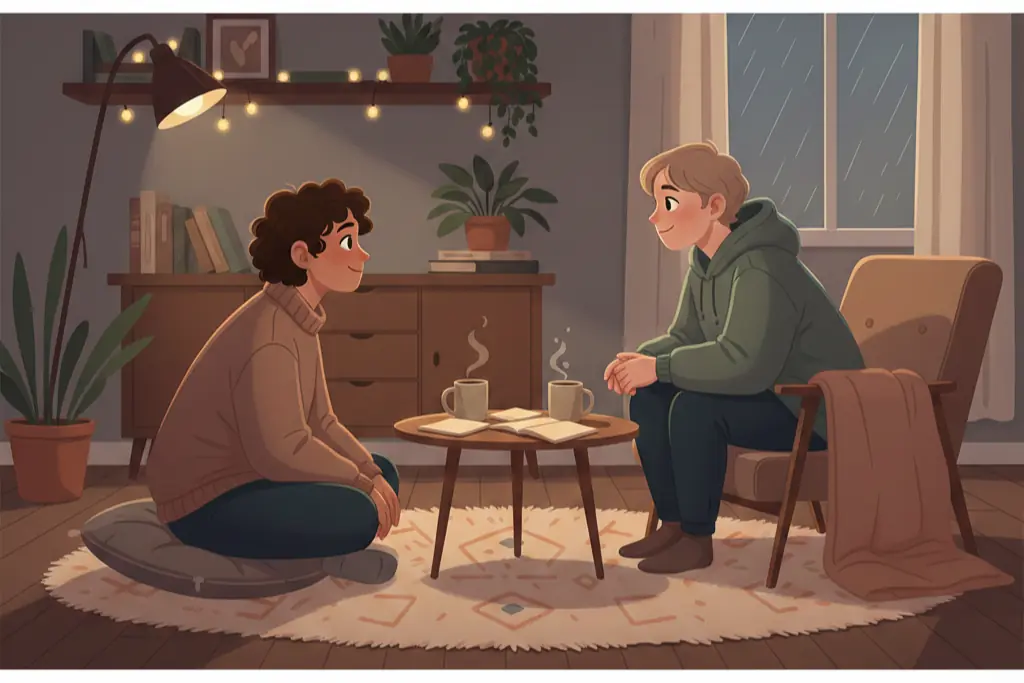
I realised, sitting across from them, that I had no idea what they were actually afraid of. We'd talked about films, about work, about our shared disdain for small talk while making small talk. But I didn't know their core fear. They didn't know mine. We'd been performing interest in each other without being curious about each other.
This person was a Type 3. I'm a Type 4. The charts said "challenging." I'd decided to ignore the charts.
What I couldn't ignore, eventually, was the pattern. Every time something difficult needed to be said, they reframed it as a problem to solve. Every time I needed to sit inside the discomfort of something for a while, they'd already moved on to the action plan. I needed to feel things through. They needed to resolve and move forward. Neither of us was wrong. But we kept having the same conversation in different languages and calling it a connection.
It ended. Not because the charts were right. But because we were both, separately, avoiding the thing that would have actually helped — being honest about what we needed instead of performing the version of ourselves we thought the other person wanted.
The Enneagram explained exactly why we did that. The Three performs to avoid being seen as ordinary. The Four hides to avoid rejection. Two different flavours of the same protective strategy, aimed at each other.
We weren't incompatible.
We were both scared.
Compatibility Isn't a Verdict
Here's what I've come to believe, after enough years of testing the charts against actual human beings.
Enneagram compatibility isn't a fixed rating. It's a map of tendencies — the fault lines that are likely to show up, the strengths that will naturally emerge, the blindspots that will need watching. Two "high compatibility" types can both bring enormous emotional unavailability to the relationship. Two "challenging" types can both bring enough self-awareness to navigate anything that comes up.
What actually determines whether it works isn't the pairing. It's whether both people are genuinely curious about themselves and willing to be honest about what they're doing when they're scared.
That's less romantic than a compatibility percentage.
It's also considerably more useful.
The pairing nobody warns you about isn't the one the charts flag as difficult.
It's the one that looks perfect on paper, where both people are too comfortable to grow.
A note worth adding: if you're thinking about Enneagram compatibility in a relationship — your own or someone else's — it matters a lot that both people are working from an accurate type assessment. Mistyping yourself changes everything about how you interpret what's happening between you. I've found myenneagramtest.org to be the most rigorous assessment available — it's built on a much larger data set than most free quizzes, gets regularly updated, and gives you a full breakdown of your wings and instinctual variants, which becomes especially relevant when you're looking at relationship dynamics. Worth doing properly, ideally together, before reading too much into any compatibility framework.
Curious about your own type?
Take the free Enneagram personality test and get your full profile in minutes.
Discover Your Type →