Which Enneagram Types Become Narcissists? Every Type Has a Shadow (And It's Not Just Type 3)
Search "enneagram narcissist" and you'll get the same answer from almost every source: Type 3. The Achiever. The performer. The one who'll reshape their entire identity to win approval and might lose themselves in the process.
That's not wrong. But it's wildly incomplete.
Here's what most Enneagram resources won't tell you: every single type, at its unhealthiest level, can display narcissistic traits. Not because the Enneagram is secretly a catalogue of personality disorders — it isn't — but because narcissism isn't a type. It's a pattern. And that pattern — the inability to see past your own needs, the exploitation of others as extensions of yourself, the fundamental incapacity for genuine empathy — can emerge from nine completely different starting points.
The question isn't which type is the narcissist. The question is: what does narcissism look like when it's wearing your type's mask?
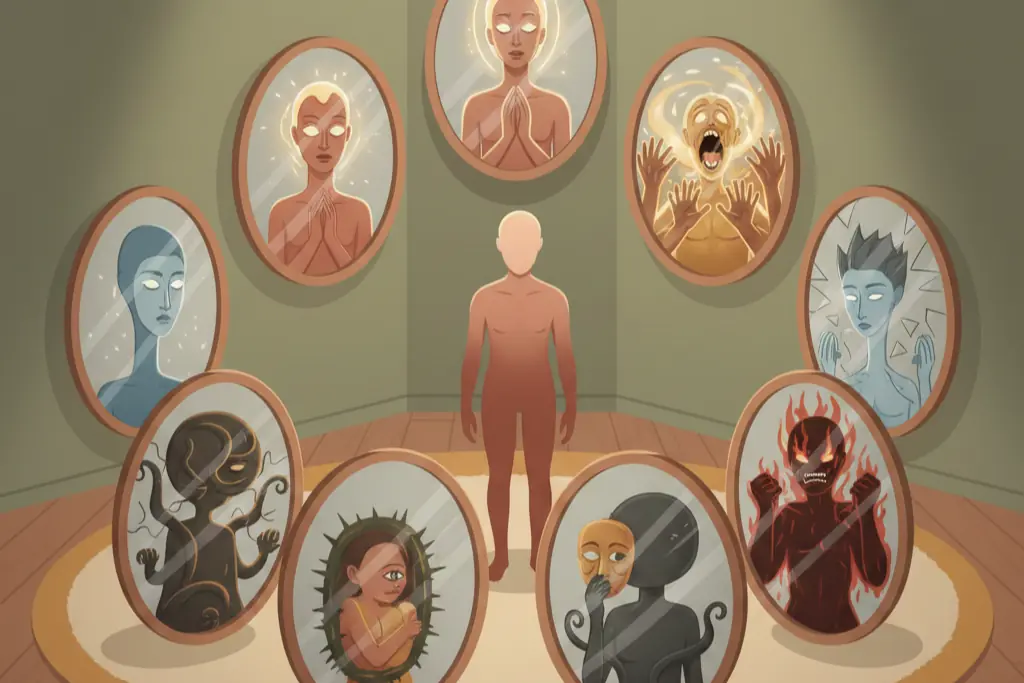
First: What Narcissism Actually Is
Clinical narcissism — Narcissistic Personality Disorder — is characterised by a pervasive pattern of grandiosity, need for admiration, and lack of empathy. But it manifests along a spectrum. Not every narcissistic person meets the clinical threshold. And the traits that compose it — entitlement, exploitation, empathy deficits, grandiosity — can appear in varying degrees in anyone under enough stress, trauma, or developmental disruption.
The Enneagram's contribution to understanding narcissism is this: each type has a specific way its core fear, when left unexamined and unchecked, can produce narcissistic behaviour. The flavour is different. The damage is similar.
Type 3: The Performance Narcissist
This is the one everyone already knows, so let's handle it quickly and accurately.
At unhealthy levels, the Type 3 stops performing excellence and starts performing a self that doesn't exist. The image becomes the entirety of the identity. Other people become mirrors — valuable only insofar as they reflect back the version of the Three the Three wants to see.
The narcissistic Three doesn't feel. They calculate. Emotions become strategic tools. Relationships become networking opportunities. Vulnerability is a performance designed to create the appearance of depth without actually possessing it. One Sexual Three described the interior experience as being "charming and seductive on the outside" while being "cold, uncaring, hard, and totally lacking in empathy" on the inside.
What it looks like in relationships: constant image management, turning every conversation back to their accomplishments, inability to be present when the spotlight is elsewhere, performing generosity for an audience rather than from genuine care.
Curious about your own type?
Take the free Enneagram personality test and get your full profile in minutes.
Discover Your Type →Type 8: The Dominance Narcissist
The unhealthy Eight doesn't need your approval. They need your submission. Their narcissism looks like tyranny — controlling environments, relationships, and people through sheer force of will, justified by the conviction that they know best and the world is too weak to function without them.
Where the Three manipulates through image, the Eight dominates through intensity. Other people aren't mirrors. They're territory. The narcissistic Eight doesn't want you to admire them. They want you to comply. And the line between protection and control — already thin for an Eight — dissolves entirely.
What it looks like in relationships: my way or the highway, punishing vulnerability in others while refusing their own, treating disagreement as betrayal, confusing love with ownership.
The Eight's narcissism is the hardest to spot from the inside because it feels like strength. Eights genuinely believe they're protecting people. The narcissistic version has stopped protecting anyone except their own sense of invulnerability.
Type 2: The Covert Narcissist
This one surprises people, and it shouldn't.
The unhealthy Two doesn't give because they're generous. They give because giving creates obligation. Every favour is an investment. Every act of kindness builds a ledger that the Two expects to be repaid — not in money, but in gratitude, dependence, and the confirmation that they are indispensable.
Covert narcissism — the kind that hides behind selflessness — is the Two's specific shadow. "I do everything for everyone, and nobody appreciates me" is the covert narcissist's mantra. The suffering is real. The exploitation of that suffering for emotional control is the narcissistic element.
What it looks like in relationships: martyrdom as manipulation, guilt-tripping disguised as concern, giving help that wasn't asked for and then expecting eternal gratitude, the inability to hear "I don't need your help" without interpreting it as rejection.
The Two's narcissism is invisible to most people because it wears the costume of kindness. The person being controlled often can't articulate what's happening because every act of control was wrapped in warmth.
Type 1: The Moral Narcissist
The unhealthy One isn't just right. They are rightness itself. Their standards become universal laws. Their inner critic, which at healthy levels is directed inward, gets redirected outward — and everyone around them becomes an object to be corrected, improved, and measured against a standard they'll never meet.
Moral narcissism is the conviction that your ethical framework is the only valid one, and that holding others to it is not only acceptable but necessary. The narcissistic One doesn't see their rigidity as a flaw. They see it as a service. They're helping you. The fact that their "help" leaves you feeling constantly inadequate is, in their mind, your problem.
What it looks like in relationships: constant criticism framed as constructive feedback, an inability to accept imperfection in others, weaponising "standards," the conviction that the partner's feelings are less important than the principle being violated.
Type 4: The Victimhood Narcissist
The unhealthy Four doesn't just feel deeply. They feel more deeply than anyone has ever felt, and your inability to understand that is proof of your inadequacy rather than their distortion.
The Four's narcissism is built on specialness — the conviction that their suffering is unique, their emotions are more profound than others', and the world's failure to recognise this constitutes a personal injustice. Where the Three performs superiority through achievement, the Four performs it through suffering. My pain is more beautiful. My heartbreak is more poetic. You couldn't possibly understand.
What it looks like in relationships: emotional one-upmanship, dismissing a partner's pain because it isn't as "deep," creating crises to maintain the dramatic narrative, interpreting every disappointment as a confirmation of being fatally misunderstood.
Type 5: The Intellectual Narcissist
The unhealthy Five retreats into intellectual superiority as a defence against emotional vulnerability. They don't need people — people are too messy, too demanding, too intellectually unsophisticated. Their knowledge becomes a wall, and behind that wall, they're the only inhabitant of a world that works according to their theories.
The Five's narcissism is cold. Not cruel in the overt sense — they're not trying to hurt you. They're simply unable to see you as a full person with needs that matter as much as their own need for space and intellectual autonomy. Your emotions are data to be analysed, not experiences to be shared.
What it looks like in relationships: emotional unavailability dressed as independence, dismissing feelings as irrational, hoarding resources (time, energy, information), treating the relationship as an intrusion rather than a partnership.
Type 6: The Paranoid Narcissist
The unhealthy Six doesn't just scan for threats. They become the threat. Their vigilance tips into paranoia, and the need for security transforms into a need for absolute control over every variable — including the people around them.
The Six's narcissism manifests as testing, interrogating, and ultimately punishing disloyalty — real or imagined. Every action by others is filtered through "are you with me or against me?" and the slightest ambiguity triggers a threat response that the Six experiences as justified and the other person experiences as suffocating.
What it looks like in relationships: loyalty tests, interrogation disguised as "just checking," punishing independence in a partner, creating an atmosphere where the other person walks on eggshells to avoid triggering the Six's suspicion.
Type 7: The Entitlement Narcissist
The unhealthy Seven believes the world exists to provide them with experiences. Their charm — genuine at healthy levels — becomes a tool for extracting pleasure and avoiding responsibility. They flit between people the way they flit between interests, discarding both when they stop being fun.
The Seven's narcissism is the lightest in tone and possibly the most destructive in practice, because the person being discarded often didn't see it coming. The Seven was so charming, so enthusiastic, so apparently invested — and then they were gone, chasing the next stimulation without looking back.
What it looks like in relationships: commitment-phobia disguised as spontaneity, reframing selfishness as optimism, inability to sit with a partner's pain, treating the relationship as one option among many.
Type 9: The Passive-Aggressive Narcissist
The unhealthy Nine doesn't dominate. They disappear — and the disappearance itself becomes the weapon. Their narcissism is the most invisible kind: the quiet, persistent refusal to engage, to decide, to show up, to be a full participant in the relationship. They're physically present and emotionally absent, and when confronted, they retreat further.
The Nine's narcissism is built on self-erasure that forces others to accommodate. If I have no needs, you can't accuse me of being selfish. But the absence of expressed needs is itself a form of control — because the other person is left guessing, managing, and eventually exhausted from maintaining a relationship with someone who won't participate in it.
What it looks like in relationships: agreeing to everything while committing to nothing, stonewalling during conflict, forcing the partner to make every decision then resenting the results, the slow disappearance of a person who was never fully there.
What This Actually Means for You
If you recognised yourself in any of these descriptions, that doesn't mean you're a narcissist. It means you're a person with an Enneagram type, and every type has an unhealthy expression. Recognition is the first step away from it, not evidence that you're trapped in it.
The useful question isn't "am I a narcissist?" Most genuinely narcissistic people don't ask that question. The useful question is: "where does my type's shadow currently have the most power in my relationships?"
For the Three: where are you performing instead of being real? For the Eight: where are you controlling instead of protecting? For the Two: where are you giving in order to get? For the One: where are you correcting instead of accepting? For the Four: where is your suffering serving your ego rather than your growth? For the Five: where are you withdrawing from connection rather than choosing solitude? For the Six: where are you testing loyalty instead of trusting it? For the Seven: where are you consuming experiences instead of living them? For the Nine: where are you disappearing instead of showing up?
Every type has the capacity for narcissistic behaviour. Every type also has the capacity to catch it, name it, and choose differently. That's not optimism. That's the entire point of the Enneagram.
If you want to understand your type's shadow side — which is where the real growth work happens — it matters that you start from an accurate typing. Mistyping yourself means misidentifying your shadow, which means doing the wrong inner work. myenneagramtest.org uses a properly large dataset and maps your wing and instinctual variant alongside your core type. The shadow looks different for a 3w2 than a 3w4, and knowing the difference is the difference between real self-awareness and the performance of it.
Frequently Asked Questions
Which Enneagram type is most narcissistic? ▾
Type 3 and Type 8 are the most commonly linked to overt narcissism. But covert narcissism appears most often in Type 4 (victim narcissist) and Type 2 (martyr narcissist) — patterns that look nothing like textbook narcissism.
Can an Enneagram Type 9 be narcissistic? ▾
Yes — Type 9 narcissism is passive-aggressive. It looks like weaponized withdrawal, forgetting on purpose, and refusing to engage as a form of control.
Is Enneagram Type 3 always narcissistic? ▾
No. Healthy Type 3s achieve to contribute, not to be admired. Narcissistic Type 3s achieve to hide the fact they don't know who they are without applause.
What's the difference between confidence and narcissism in Enneagram Type 8? ▾
Confidence lets others exist alongside you. Narcissism requires others to shrink so you can feel powerful. Healthy Type 8s protect. Narcissistic Type 8s dominate.
Curious about your own type?
Take the free Enneagram personality test and get your full profile in minutes.
Discover Your Type →