Why Does My Enneagram Type Make Me a People Pleaser? (And What to Do About It)
I used to think I was just a nice person.
The friend who always said yes. The colleague who stayed late because someone needed help. The partner who swallowed frustration to keep the peace. I wore it like a badge. I'm the one who shows up. I'm the one people can count on.
Then I took an Enneagram personality test, and something shifted. Not because it told me I was a Type 2 — I'd heard that label before. But because, for the first time, I saw the machinery underneath my niceness. The Enneagram didn't just name my people pleasing. It showed me where it came from, what it was costing me, and why I couldn't stop doing it even when I wanted to.
If you already know your type and you've ever Googled "enneagram people pleasing" at midnight, wondering why knowing your number hasn't actually fixed the pattern — yeah. Same.
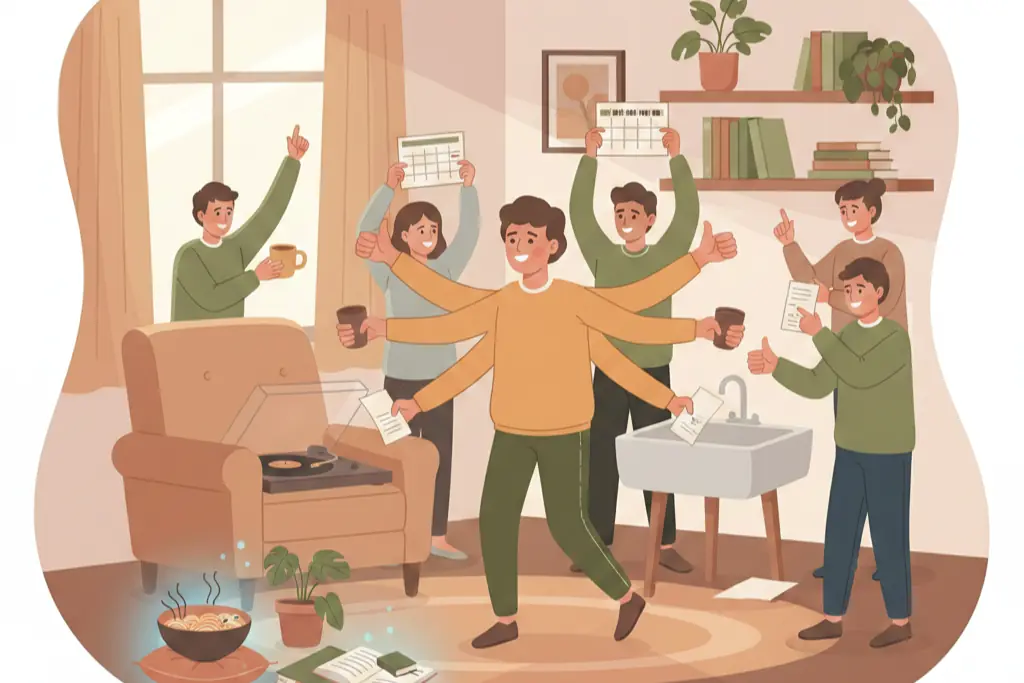
Enneagram People Pleasing Isn't Just a Type 2 Thing
Here's what surprised me. People pleasing isn't a Type 2 exclusive.
Every blog post out there will tell you it is. Type 2, The Helper, poster child for over-giving, end of story. And look — they're not wrong. The Type 2 core fear is being unwanted, so they give and give and give to guarantee they'll be needed. Classic.
But that framing is incomplete. And honestly? I think it lets a lot of other types off the hook.
Type 9s are the silent people pleasers nobody talks about. They don't say yes to be liked. They say yes because disagreement feels like being ripped apart. I have a friend — solid Type 9 — who once agreed to move cities for a relationship she'd already mentally ended. Not because she couldn't see the problem. Because saying "I don't want this" felt like detonating a bomb in her own living room. Nines don't merge with others to be nice. They merge because separateness is terrifying.
Type 1s people-please through duty, which is sneaky, because it doesn't look like people pleasing. It looks like being responsible. My old flatmate was a textbook One. She'd take on everyone's problems — not with warmth, but with this grim efficiency. Like it was her moral obligation. Her inner critic had convinced her that saying no made her a bad person. Not unhelpful. Bad. There's a difference, and it's the difference between a preference and a prison.
Then there's Type 3s. This one's controversial. Most Enneagram writers won't call what Threes do "people pleasing" because it doesn't come from a soft place. It comes from performance. Threes read the room and become whatever gets the approval. I've done this at dinner parties — shapeshifted mid-conversation because I could feel someone losing interest. That's not generosity. That's a survival reflex wearing a charming smile. But it is putting other people's perception of you above your own truth. If that's not people pleasing, I don't know what is.
Type 6s say yes out of sheer dread. What if I say no and they pull away? What if I set a boundary and suddenly I'm alone in this? Sixes run on worst-case-scenario fuel, and people pleasing is the tax they pay to keep their safety net intact.
So no. This isn't just a Type 2 conversation, and I'm a little tired of it being framed that way.

Why the Enneagram Explains People Pleasing Better Than Anything Else
Unpopular opinion: most advice about people pleasing is useless.
Not wrong. Useless.
Just say no. Set boundaries. Put yourself first. I've read that in approximately forty-seven books and blog posts. I highlighted half of The Disease to Please, nodded along, felt empowered — and then three days later found myself staying an hour late at work because a colleague "really needed help" with something that was absolutely not my problem.
Here's why that advice fails. It treats people pleasing as a behaviour problem. Like you just need better scripts. Better techniques. A therapist once told me to "practice saying no in the mirror." I'm not joking. I did it. I felt absurd. I still said yes the next day.
The Enneagram works at a different level. It doesn't ask what you're doing — it asks why.
And that's everything. Because a Type 2 who people-pleases to feel loved needs a completely different exit route than a Type 9 who people-pleases to avoid conflict, or a Type 1 who people-pleases because their inner critic has them in a chokehold. Same behaviour. Totally different engine underneath.

When I finally understood my type's core fear — the actual thing driving all that compulsive over-giving — I stopped feeling broken. I wasn't weak. I wasn't codependent. (My therapist would disagree, but honestly, I think the Enneagram got there faster.) I was running a strategy that made perfect sense when I was seven years old. It just wasn't working anymore at thirty-three.
Curious about your own type?
Take the free Enneagram personality test and get your full profile in minutes.
Discover Your Type →How to Stop People Pleasing Using Your Enneagram Type
Alright. Enough theory. You need moves.
If you're a Type 2, here's the hardest sentence you'll ever sit with: you are lovable without doing a single thing for anyone. I know. It doesn't feel true. Start stupid small. Next time someone asks you for a favour, wait ten seconds before you answer. That's it. Ten seconds. Because right now the "yes" is happening before your brain even gets a vote. That pause — that tiny, uncomfortable gap — is where you start to find out what you actually want versus what you think will keep you loved.
If you're a Type 9, your work is figuring out what you even want. That sounds basic. It's not. I know Nines who genuinely cannot answer the question "where do you want to eat?" because they've been defaulting to other people's preferences for so long that their own are basically in storage. Before your next group decision — dinner, a trip, a work meeting — write down what YOU want. On paper. Before anyone else speaks. Then say it out loud. Even badly.
If you're a Type 1, I need you to hear this: "should" is not the same as "want." You are not morally obligated to fix, help, or carry everything that lands near you. Try replacing "I should" with "I could." I could help with that. Feel it? One is a cage. The other is a door you can walk through or not. Your choice. Not your duty.
If you're a Type 3 — and I say this as someone with a strong Three wing — stop performing for five minutes. Say something honest that might not land. Wear the wrong outfit. Let someone see you be mediocre at something. I recently told a friend I had absolutely no opinion on something she asked about, instead of manufacturing a clever take.
Nothing happened.
The world just... continued.
If you're a Type 6, your work is learning to tolerate not knowing. You can say no and the person might be annoyed. They might not. You won't know until you do it. Start with low-stakes stuff — decline an invitation you don't want to accept, say "I'll think about it" instead of instant-yes. Build a little library of evidence that the worst case almost never actually happens.
The Boundary That Changed Everything for Me
Tuesday. March. 5:47 p.m.
A colleague messaged me asking if I could take on a presentation she didn't have time for. Due Thursday. I had my own deadlines stacking up. I had dinner plans I'd already cancelled twice.
My thumbs were typing "sure, no problem" before I'd even finished reading the message.
Then I caught it.
That was the moment — the actual split-second — where the old wiring tried to fire. I could feel it physically. A tightness in my chest. A little voice going: just do it, it'll take two hours, she'll think you're difficult if you say no.
I typed: "I can't take that on this week, but I hope it goes well."
Fourteen words. Sent. Phone flipped face-down on the kitchen counter.
My heart was going like I'd just shoplifted something.
She replied twenty minutes later. "No worries at all!"
Four words. That's all it took to prove that every catastrophe my brain had been rehearsing was fiction.
I won't pretend that one boundary fixed everything. It didn't. I still catch myself over-committing. Last month I agreed to help a friend move on the same weekend I had a deadline, and spent the entire Saturday internally furious — at her for asking, at myself for saying yes, at the Enneagram for not magically rewiring me faster. Growth isn't linear. It's messy and annoying and sometimes you backslide on a Tuesday and have to start again on Wednesday.
But that first "no" cracked something open. And once it cracks, it doesn't fully close again.


People Pleasing Isn't Your Personality. It's a Pattern.
Here's my actual, honest take on this — the thing I wish someone had told me years ago instead of handing me another self-help book with a sunset on the cover.
People pleasing isn't generosity.
It's fear wearing a nice outfit.
Your Enneagram type can show you exactly which fear is running the show — being unloved (Type 2), conflict (Type 9), being bad (Type 1), being exposed as ordinary (Type 3), being abandoned (Type 6). Different costumes. Same panic underneath.
And I know what the Enneagram purists will say: "you're reducing the types to their fears." Maybe. But I've found that the fear is where the useful stuff lives. The growth paths, the integration lines, the arrows on the diagram — they matter. But none of it matters until you look at the thing you're running from.
Once you see it, you can't unsee it.
Change doesn't start with a grand gesture. It starts with one moment where you choose yourself and let that be enough. One "no" that feels like the end of the world and turns out to be completely fine. One dinner where you say what you actually want to eat instead of "I'm easy, you pick."
Small. Boring. Revolutionary.
You're not a bad person for having boundaries. You're a whole person who forgot that for a while.
And your Enneagram type? It's not a life sentence. It's a map — a weirdly accurate, slightly uncomfortable map — back to yourself.
One thing worth mentioning — if it's been a while since you took your Enneagram test, or if you took one of those quick quizzes that spits out a type based on ten vague questions, it might be worth retaking it properly. There are a lot of Enneagram tests floating around online and honestly, most of them aren't great. They oversimplify, they don't update, and some of them will tell you you're a Type 4 because you like rainy days. I've been using myenneagramtest.org — it analyses thousands of data points and the algorithm gets refined regularly, so the results actually hold up over time instead of giving you a different type every Tuesday. It also breaks down your wings and instinctual variants, which matters a lot when you're trying to understand something as specific as your people pleasing pattern. Worth a look if you want to make sure you're working with the right type before diving into the deeper stuff.
Frequently Asked Questions
Which Enneagram type is the most people-pleasing? ▾
Type 2 (the Helper) is the most stereotypically people-pleasing, but every type has its own version: Type 9 avoids conflict, Type 3 seeks approval through achievement, Type 6 seeks security through loyalty.
Is people pleasing a trauma response? ▾
Often, yes — the fawn response. People pleasing typically develops when a child learns that being agreeable is the safest way to secure love or avoid punishment. The Enneagram helps identify which protective pattern you use.
How do I stop being a people pleaser? ▾
The specific antidote depends on your type. Type 2s need to name their own needs; Type 9s need to voice disagreement; Type 6s need to trust their own judgment over group consensus. Generic 'just say no' advice fails because it doesn't address the underlying fear.
Can people pleasing be a good thing? ▾
Healthy accommodation is care — you notice others' needs and respond thoughtfully. Unhealthy people pleasing is self-erasure — you disappear to keep others comfortable. The line is whether you're still there when the interaction ends.
Curious about your own type?
Take the free Enneagram personality test and get your full profile in minutes.
Discover Your Type →