Enneagram 6w5: The One Who Manages Anxiety by Knowing More Than Everyone Else
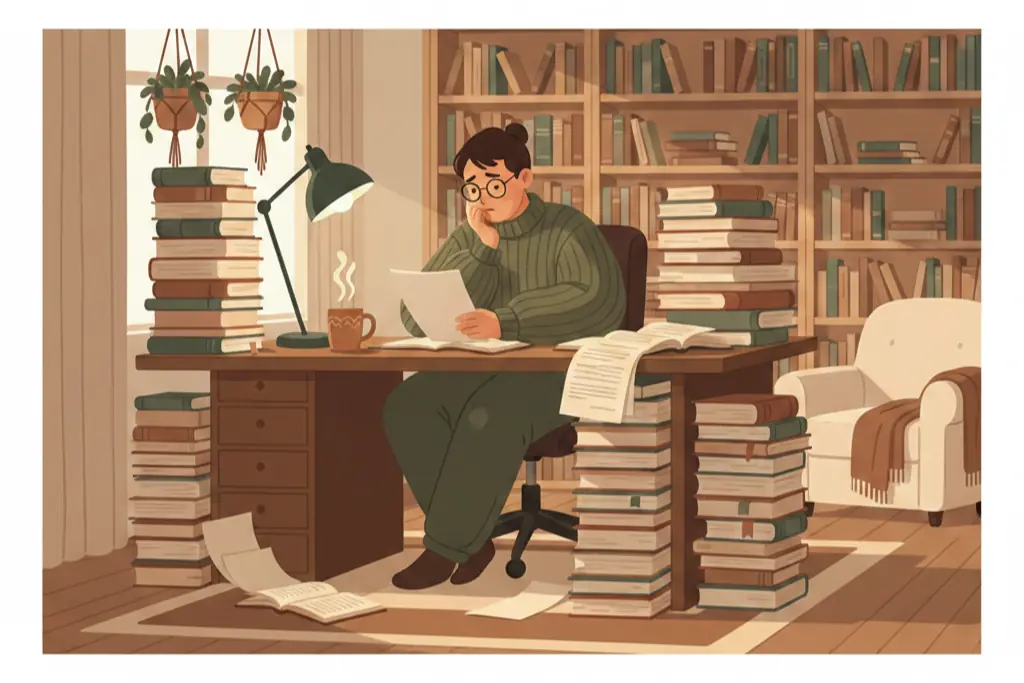
There's a specific kind of person who responds to uncertainty by becoming undeniably competent. Who reads everything, prepares everything, questions everything — not out of arrogance but out of a deep need to not be caught unaware. The enneagram 6w5 is that person. The Six's core anxiety about safety and support finds a Five-shaped outlet: if I know enough, understand enough, and depend on others as little as possible, then I'll be okay. It's a coherent strategy. It's also exhausting to maintain indefinitely. But to the 6w5, the exhaustion feels better than the alternative: vulnerability and uncertainty.
How Enneagram 6w5 Manages the Fear of Being Unsupported
The Six's core fear is being without support, guidance, or a stable foundation. Most Sixes manage this by building trusted relationships and communities — people and institutions they can rely on. The enneagram 6w5 adds a different mechanism: self-sufficiency. The Five wing's drive toward knowledge and competence gives the 6w5 a way of building internal support rather than just external support. If I know enough, I don't need to depend on anyone else to be safe.
This creates a Six who operates more independently than most. Less visibly anxious in social situations, more likely to research rather than ask for help, more comfortable working alone for sustained periods. It can look like confidence — and in some real sense it is. But underneath the self-sufficiency is still the Six's fundamental question: is this going to hold? The difference from 6w7 is texture. Where 6w7 manages anxiety through connection and warmth, 6w5 manages it through expertise and distance. The 6w5 will say "I researched it" while 6w7 will say "I talked to my people about it." Both are trying to reduce uncertainty, just through completely different pathways.
The Enneagram 6w5 at Work and Under Stress
The enneagram 6w5 tends to be exceptional at roles that reward rigorous thinking and deep preparation. They identify risks others miss. They don't accept reassurance without evidence. They're often the person in the room who asks the uncomfortable question that everyone was avoiding — not to cause problems, but because they've already run the scenario where nobody asked and it was bad. In technical fields, startups, risk management, or any environment where real preparation prevents real disaster, the 6w5 is invaluable. They're the person who actually reads the terms of service and understands the implications. They're the one who knows what needs to be done before anyone else even knows there's a problem.
Under stress, the vigilance intensifies. More analysis, more scanning for what could go wrong, more suspicion about information that doesn't fit the model. The Six's counter-phobic tendency — confronting feared situations head-on as a way of asserting control over the fear — can combine with the Five's tendency toward withdrawal in complex ways. Sometimes the 6w5 under stress isolates and researches. Sometimes they go toward the feared thing aggressively. Which response dominates tends to depend on how much they trust the domain. In familiar territory, they often become more assertive under pressure. In unfamiliar territory, they can shut down.

What Enneagram 6w5 Actually Needs
The self-sufficiency strategy, when it works, is genuinely impressive. But it has limits. The enneagram 6w5 who never lets anyone be a source of genuine support is always one piece of bad information away from complete destabilisation. The Five wing's drive toward self-containment can become a way of avoiding the vulnerability of actually trusting someone — which is, ultimately, the thing the Six most needs to practice. Growth for this combination usually involves finding one or two people or institutions that can actually be trusted, and then actually trusting them. Not as a dependency, but as a genuine acknowledgement that the self-sufficiency strategy, however sophisticated, is still a response to fear. That learning changes everything.
Want the full picture? M. Ellison's guide to enneagram wings explains how wings work across all nine types. And if you're not certain which type you actually are, myenneagramtest.org gives a full result breakdown including your wing.