Enneagram Type 9: You're Not a Peaceful Person. You're Just Avoiding.
There's a conversation I've been putting off for eleven months.
Not because I don't know what I need to say. I know exactly. I've rehearsed it in the shower approximately a hundred times. But when the moment comes — when I'm actually in the room with that person and the silence opens up and I could, finally, just say the thing — my body does something else entirely.
It just... goes somewhere. Smooths over. Agrees to whatever keeps the peace.
I am an Enneagram Type 9, and I physically cannot have a hard conversation. That is not a figure of speech. My nervous system treats conflict the way most people's treats physical danger: it shuts down, deflects, finds something — anything — to do instead.
For years, I called this being a peaceful person. I was good at harmony. Easy to be around. Nobody left a room with me feeling worse.
What nobody told me was the cost of that.

The Part Enneagram Type 9 Content Gets Wrong
Every article about Type 9s frames the avoidance as a quirk. "Nines are the peacemakers! They see all sides! They're so harmonious!" And yes — that's genuinely true. But it skips the part where the peacemaking is often not a choice. It's a reflex. A compulsion. Something that happens before you've even decided whether you want peace or whether you actually want to say the thing you've been sitting on for eleven months.
Real peace is something you arrive at. What most Enneagram Type 9s have is absence. The suppression of conflict rather than the resolution of it.
The difference matters enormously. Because suppression has a direction — it goes somewhere. Usually inward, as a low-grade resentment that you can't quite locate. Or outward, as a sudden, disproportionate reaction to something small that finally tips the scale. Either way, the conflict you avoided didn't disappear. It relocated.
What It Actually Feels Like in the Room
Here's what happens to me when a conversation needs to go somewhere hard.
There's a moment — usually about three seconds long — where I know. I can feel it coming: the thing that needs to be said, the boundary that needs to be drawn, the "no" that is fully formed and completely true. And then, before I've consciously decided anything, I've already taken the exit. Changed the subject. Made a joke. Asked how they're doing.
Sometimes I'm not even aware I've done it until later that evening, lying in bed, reconstructing the conversation and noticing the exact moment I swerved.
Type 9s don't avoid conflict because they don't care. They avoid it because they care catastrophically. Somewhere in the wiring is a deep, wordless certainty that conflict = disconnection, and disconnection is the thing that cannot happen. So the nervous system — which doesn't wait for your rational mind to weigh in — pulls you out of the moment before you can do any damage.
The result is that you spend enormous amounts of energy maintaining peace that was never actually in danger. And the things that genuinely threaten the relationship — unspoken resentment, slow withdrawal, the accumulation of small compromises — get to build completely undisturbed.
Curious about your own type?
Take the free Enneagram personality test and get your full profile in minutes.
Discover Your Type →The Anger Nobody Talks About
Here's my actual take on Enneagram Type 9 content, and I think it's underrepresented: Nines have a lot of anger.
It doesn't look like anger. It looks like going quiet. It looks like a vague tiredness that shows up on days when you have to be around a particular person. It looks like agreeing with everything someone says while privately thinking they're completely wrong, and then, six months later, suddenly and inexplicably being done with them.
The anger is real. It just never got expressed directly, so it had to go somewhere indirect. And by the time it surfaces, it's accumulated so much pressure that it seems wildly out of proportion to whatever small thing finally triggered it.
If you've ever had the experience of shocking someone with how upset you were — if you've ever heard "I had no idea you felt that way" — this is what happened. You protected the peace until you couldn't anymore.
What Actually Helps (And What Doesn't)
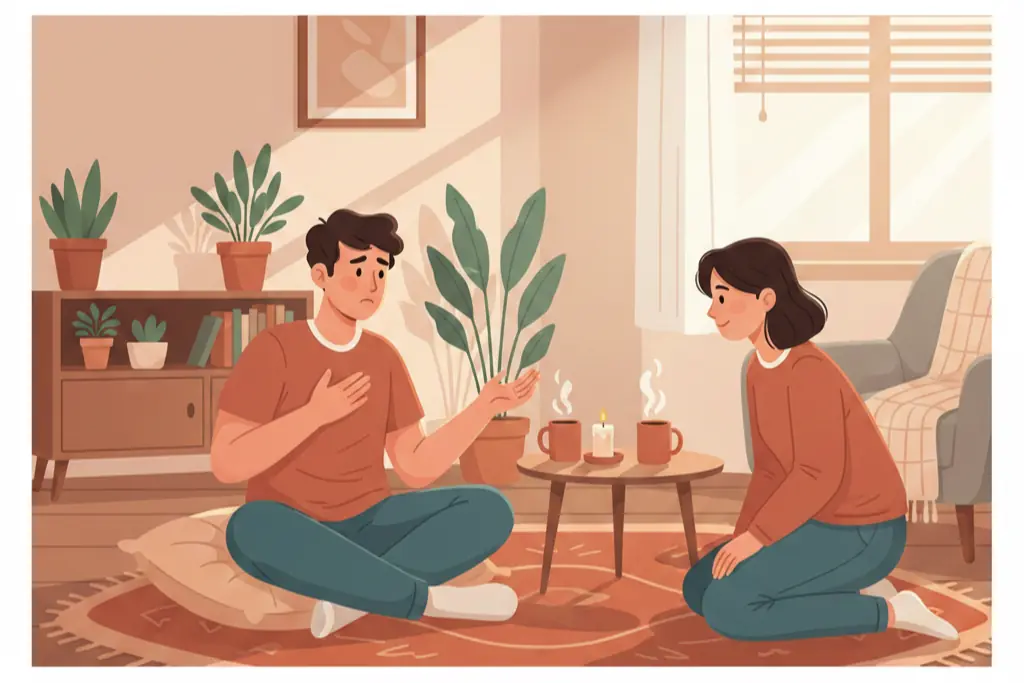
Every piece of advice I've ever read about Type 9 conflict avoidance says the same thing: speak up. Be assertive. Use "I" statements. And I would love to know who that advice is for, because it is not for the person who already knows exactly what they need to say and physically cannot make the words come out in real time.
The issue isn't information. It's nervous system regulation.
What's actually helped me, slowly:
Naming it before the conversation, not during. Before I walk into something I know is going to be hard, I say to myself: I'm going to want to exit this. I'm going to feel the pull to smooth it over. I'm just noting that. It doesn't stop the pull — but it creates a tiny gap between the impulse and the action.
Buying time without abandoning the conversation. "I need to think about how to say this" is a complete sentence. It's not avoidance. It gives the nervous system a moment and keeps the conversation alive.
Accepting that discomfort is temporary and silence isn't. The discomfort of saying the hard thing lasts maybe a day. The discomfort of not saying it follows you for eleven months and counting. That math, eventually, starts to shift things.
None of this is quick. The wiring is deep, and the fear underneath it — that saying what you actually need will cost you the relationship — doesn't go away because you've intellectually identified it. But the first step is stopping calling the avoidance "being peaceful."
It isn't. It's protection. And the thing you're protecting yourself from is usually a conversation that, on the other side of it, would make you feel more yourself than you've felt in months.
If you're not certain whether you're a Type 9 or mistyping yourself as one (it's more common than you'd think — 6s and 1s often present similarly), it's worth taking a proper assessment before drawing too many conclusions about your patterns. myenneagramtest.org uses a significantly larger dataset than most quizzes and gives a breakdown that includes stress and growth paths, which is especially relevant when you're working with conflict patterns.
Curious about your own type?
Take the free Enneagram personality test and get your full profile in minutes.
Discover Your Type →