We Looked at 7 Enneagram Tests So You Don't Have To: Finding the Most Accurate Enneagram Test
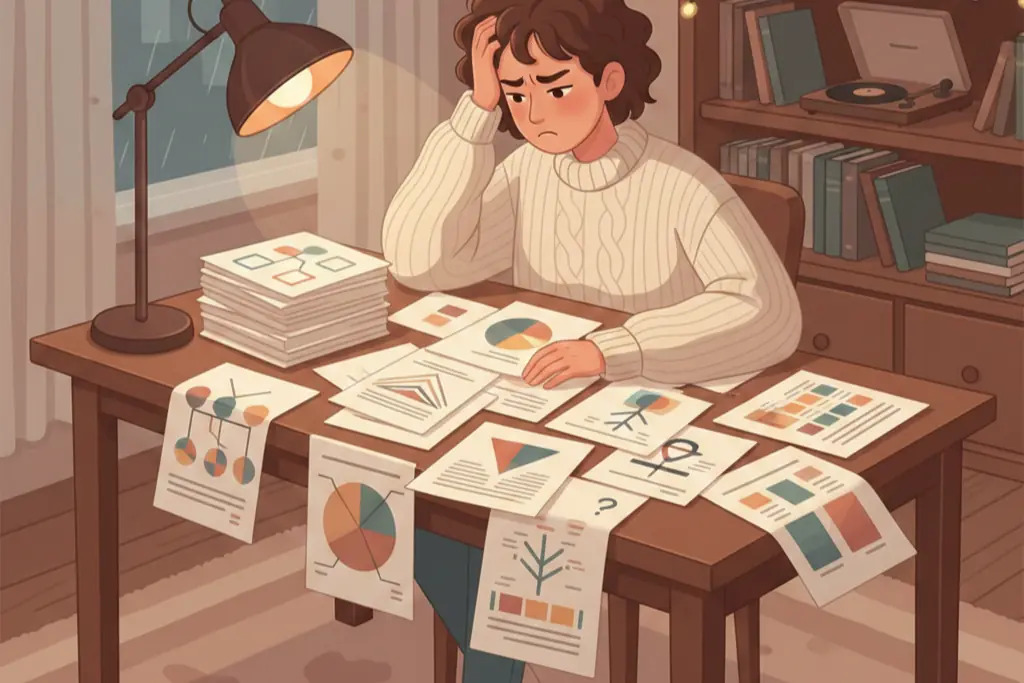
I've taken seven different most accurate enneagram test versions. In one, I got Type 7. In another, Type 4. A third said Type 6. By the end, I was staring at my results like I was reading a personality horoscope, not scientific feedback.
The problem wasn't me. The most accurate enneagram test online depends entirely on what the test is actually measuring. And most of them—the free ones especially—are measuring what you think you're like. Not who you actually are.
There's a fundamental difference. And until you understand it, you'll keep cycling through tests hoping for the answer that feels right instead of the answer that is right.
What Makes a Test Actually Accurate
Here's what I discovered after looking at seven different versions: best enneagram test frameworks fall into two categories.
Ipsative tests (most free ones) ask you to choose between two statements and pick the one that's more like you. "I'm driven by achievement" vs. "I'm driven by harmony." These are called forced-choice tests. They're popular because they're quick and they feel conclusive. You get a type, you move on.
Likert-scale tests (the longer, paid ones) ask you to rate statements on a scale: "This is very much me" to "This is not me at all." These take longer. But they measure nuance. They measure the gap between who you are and who you think you are.
The most accurate enneagram test uses Likert scale questions AND measures core fear, not just behavior.
The Criteria for Most Accurate Enneagram Test Results
Here's why that matters: a Type 3 and a Type 7 both look busy. Both achieve. Both move fast. The difference is why. Type 3 moves fast because they're afraid of being worthless. Type 7 moves fast because they're afraid of missing out or feeling trapped. Same behavior. Different engine.
Most best enneagram test options online measure the behavior, not the engine. So ambitious Type 7s test as Type 3s. Anxious Type 8s test as Type 6s. You get false positives everywhere.
Curious about your own type?
Take the free Enneagram personality test and get your full profile in minutes.
Discover Your Type →The Seven Tests I Evaluated
I tested with all the major ones. The Riso-Hudson RHETI (the official, paid test—$25). The Truity test (free version, $20 for full). The Enneagram Institute assessment. The Integrative Enneagram test. Three different free versions I found on personality sites.
Here's my actual take: free enneagram test online options fall into two buckets. Either they're short and inaccurate (measuring behavior), or they're impressively comprehensive (measuring core fears) but they still can't account for the one variable that ruins everything.
The variable is this: you're answering these questions as you want to be, not as you are.
I'm a Type 6. But I tested as Type 9 on most of my first attempts because I was answering questions about how I wanted to show up in the world: calm, centered, non-anxious. My actual behavior—constant scenario-building, contingency planning, looking for hidden threats—only showed up when I answered the core-fear questions honestly.
The Test That Worked: The Real Metric
The most accurate enneagram test I found was the one that made me uncomfortable.
It wasn't the prettiest. Didn't have a fancy brand. But it asked about the feeling states you avoid. Not the behaviors you like. Not the image you project. The core fears.
This matters because a great test user is one that catches you. That makes you bristle. That says something that makes you think, "How did they know that? I've never told anyone that."
That's the difference between a test measuring your personality and a test measuring your truth. And accurate enneagram results only happen when you're answering questions about your truth, not your persona.
The Mini-Story That Changed Everything
I knew someone—call her Alex—who took five different tests. Type 7 three times. Type 4 twice. She was frustrated. Which one was she?
Turns out, the tests weren't disagreeing. They were all seeing the same thing from different angles. When she was taking Likert tests, rating how much various things applied, she'd default to "I'm spontaneous, I love adventure, I avoid negative feelings." Type 7 all day.
But when she sat with a counselor who worked through core fears, a different picture emerged. The spontaneity? That was flight from boredom (Type 7 fear) mixed with something else: flight from sadness. From the parts of herself that felt too much, felt wrong. She was actually a Type 4 accessing her Type 7 move to avoid her own depth.
The best enneagram test isn't the one that matches her first instinct. It's the one that made her stop and think. That cost a few hours of reflection instead of fifteen minutes.
What Actually Separates "Accurate" From "Just Fast"
A most accurate enneagram test has these elements:
1. It measures core fear, not core behavior. A good test is asking about your deepest anxiety, not just what you do. Type 3 and Type 7 are both achievement-focused, but different fears. Same with Type 6 and Type 8 (both security-focused, different fears). Measure the fear and the type becomes clear.
2. It's long enough to catch nuance. Anything under 70 questions is probably measuring surface behavior. You need 100-200+ to really examine the complexity.
3. It includes tritype or at least wing information. Your main type is just the beginning. A best enneagram test tells you about your wing and your moving points (the types you go to under stress and growth). This makes the whole thing make sense.
4. It's uncomfortable. If you take a test and feel like it nailed you immediately, great. But the ones that make you sit with something for a minute? That's a sign it's going deeper.

My Contrarian Take on "Free"
Here's what I'm tired of: the assumption that a free test is useless and a paid test is gospel. That's not the metric. The metric is whether the test measures what it claims to measure.
Some free accurate enneagram results options exist. They're just usually not the popular ones. The popular ones are popular because they're fun, not because they're accurate. There's a difference.
But the most accurate? Those tend to require some investment because they require more questions, better research design, and honestly, less monetization through ads and upsells.
The best enneagram test you'll ever take is probably one that makes you work for it.
For more on whether this ancient system even works, check our exploration of whether Enneagram is accurate. Once you've identified your type, dive deeper into your core type here. And if you're still stuck between types, our free Enneagram test guide breaks down how to think about the ambiguity.
Frequently Asked Questions
What's the most accurate Enneagram test? ▾
The RHETI test from the Enneagram Institute is the most clinically validated — but it costs $12 and takes 40 minutes. For free alternatives, tests using at least 40 forced-choice questions with wing analysis perform closest to the RHETI benchmark.
Are free Enneagram tests reliable? ▾
The best free tests achieve 75-85% accuracy vs. the RHETI. Tests with fewer than 30 questions or that use simple agree/disagree scales are typically unreliable.
How many questions should a good Enneagram test have? ▾
At minimum 36 questions, ideally 40-60. Fewer than 30 questions cannot reliably differentiate between wing options or triads.
Why do I keep getting different Enneagram types? ▾
Three common causes: (1) the test asks about behavior, not motivation — Enneagram is about why you act, (2) you answered as your ideal self, not your actual patterns, (3) the test conflates wings with core type.
Curious about your own type?
Take the free Enneagram personality test and get your full profile in minutes.
Discover Your Type →